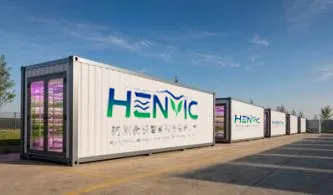
Leafy greens and microgreens are the crops that made container farming commercially legible, largely because their short cycles and high planting density tolerate the tight economics of a sealed box. The engineering challenge is not getting them to grow; it is holding root-zone chemistry and canopy microclimate stable enough that a 21-day cycle produces uniform, saleable plants rather than a graded mix of marketable and culled material.
Nutrient delivery systems fall into three practical families. Nutrient film technique runs a shallow continuous film past bare roots in channels, giving excellent oxygen access and easy inspection but little buffering capacity: a pump failure or a root mat blockage can desiccate a crop within an hour. Deep water culture is more forgiving thermally and chemically, with a large reservoir acting as a buffer, but it carries more water mass and demands vigorous aeration. Media-based systems with drip or sub-irrigation offer the most stability per plant and the easiest handling of seedlings and transplant, at the cost of media disposal and per-cycle labour. For containerised production, the choice usually turns on labour availability rather than agronomy.
Root-zone chemistry is the variable most often mismanaged. Electrical conductivity for leafy greens typically sits in a moderate band, roughly 1.2–1.8 mS/cm depending on species and light level, with pH held near 5.5–6.0 to keep iron, manganese and phosphorus available without tipping into micronutrient toxicity. The trap is drift: as plants take up water faster than nutrients in high-VPD conditions, EC climbs, and the operator compensates by adding water, which then dilutes everything else. Continuous monitoring with automated dosing and a daily reset to target is far more reliable than periodic manual adjustment. Alkalinity in the make-up water is the hidden driver of pH rise, so source-water carbonate content should be measured and neutralised with acid rather than chased with pH-down additions after the fact.
Light drives both yield and quality architecture. Daily light integral targets for lettuce and similar crops generally fall in the low-to-mid teens of mol/m²/day, with higher values improving density and head weight up to the point where tipburn and bolting risk rise. Because the fixture spectrum and efficacy determine the electrical and cooling load, the practical optimisation is to run a moderate intensity over a longer photoperiod rather than chasing peak PPFD. Spectral choice should follow crop response: a balanced red-dominant spectrum with adequate blue supports compact morphology, while far-red inclusion can accelerate expansion and stretch, which is useful for some herbs and counterproductive for head lettuce.
Tipburn is the canonical container-grown leafy green defect and is a microclimate problem disguised as a calcium problem. Calcium moves with transpiration, so inner leaves in a dense canopy under still air receive little, and the margin necroses. Raising calcium in solution does not fix it. The effective levers are horizontal airflow across the canopy, a VPD that keeps transpiration moderate and continuous through the dark period, and cultivar selection. A container with good bulk-air control but no canopy-level air movement will still produce tipburn.
Microgreens compress all of these issues into a seven-to-fourteen-day window and add their own: blackout germination requires a separate dark environment, seeding density governs airflow and disease risk, and harvest is a labour-dominated operation that should shape the layout before the benches are fixed. Because the cycle is so short, contamination introduced at seeding has no time to be outcompeted, so tray sanitation and seed lot quality become primary controls.
The operational lesson across all leafy systems is that stability beats optimisation. A container that holds EC, pH, VPD and DLI within tight bands through a full cycle will outperform a system tuned to a higher peak yield that drifts between cycles, because consistency is what makes harvest scheduling, labour planning and buyer contracts possible.